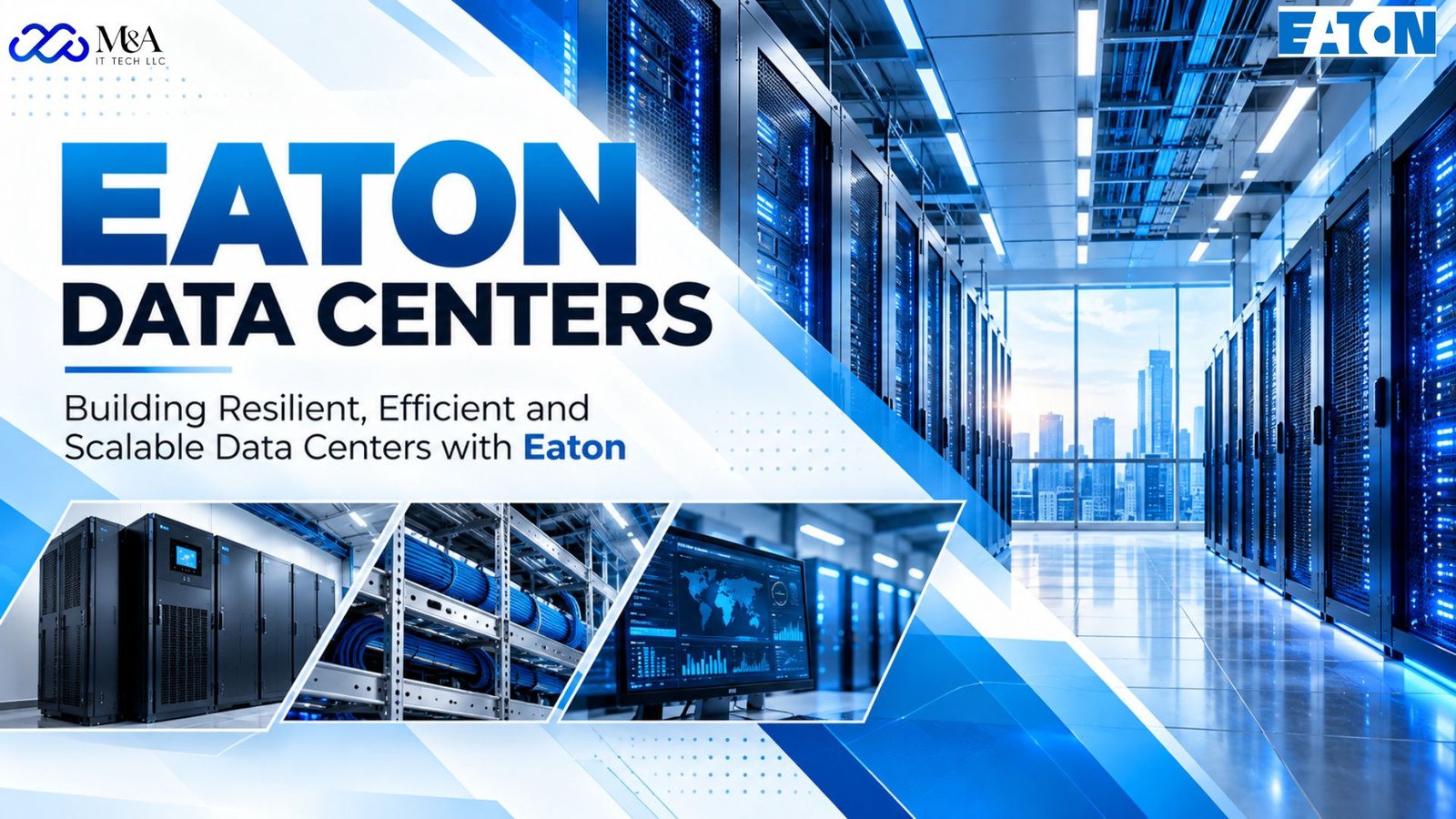
EATON • DATA CENTERS Building Resilient, Efficient and Scalable Data Centers with Eaton
Data centers have become the operational backbone of cloud services, artificial intelligence, enterprise applications, communications and digital commerce. As computing density rises, operators must deliver more power to critical IT loads while protecting uptime, controlling energy costs and preparing infrastructure for future growth. Eaton’s data-center portfolio addresses these priorities through integrated power protection, distribution, monitoring and energy-management technologies.
Why Data Center Power Infrastructure Matters More Than Ever
Modern facilities are no longer designed around a static IT load. Cloud expansion, edge computing and AI workloads can create higher-density and more dynamic demand. This places greater pressure on the electrical path from utility or on-site generation to the rack. A well-designed architecture must therefore protect sensitive equipment from power disturbances, maintain service during interruptions and provide the visibility needed to manage capacity intelligently.
Eaton describes today’s data-center challenge as a need to scale quickly and securely while improving sustainability, efficiency and economics. Its current infrastructure approach also emphasizes coordinated systems—including UPS platforms, battery energy storage, modular infrastructure, microgrids and intelligent power distribution—rather than treating each layer as an isolated component.
Core Eaton Capabilities for Data Centers
1. Uninterruptible Power Supply (UPS) Protection
UPS systems are a central layer of data-center resilience. They condition incoming power and provide backup energy when utility power is interrupted or unstable. For server rooms and critical racks, online double-conversion UPS designs can provide continuous conditioned power, helping isolate sensitive IT equipment from common electrical disturbances. Eaton offers UPS platforms across network closets, enterprise server rooms and large data-center environments.
2. Scalable Power Distribution
Power protection is only part of the equation. Facilities also need organized and scalable distribution from the UPS to downstream loads. Rack power distribution, bypass and distribution modules can simplify deployment, support maintenance strategies and help operators adapt to changing rack requirements. Designing distribution with future capacity in mind can reduce disruptive rework as the environment grows.
3. Monitoring, Visibility and Intelligent Management
Connected power infrastructure gives operations teams better insight into load, capacity, alarms and equipment health. Eaton highlights digital monitoring and data-center software as tools for improving operational visibility and supporting more informed energy decisions. For distributed environments, remote management can be especially valuable because teams can identify issues without relying solely on physical inspection.
4. Efficiency and Sustainability
Energy efficiency has direct implications for operating cost and sustainability goals. Eaton promotes high-efficiency UPS operating modes, energy-management software and grid-interactive approaches that can help facilities use power more effectively. The right design should balance efficiency with the availability and redundancy requirements of the workload.
5. Infrastructure for AI and High-Density Computing
AI infrastructure is increasing electrical density and introducing more dynamic load behavior. Eaton’s current data-center strategy includes integrated energy architectures that can combine on-site generation, battery energy storage, grid-interactive UPS systems, microgrids and modular systems. The objective is to improve resilience and deployment flexibility while supporting higher-density compute environments.
6. Resilience, Safety and Cybersecurity
Data-center availability depends on more than backup runtime. Electrical safety, maintainability, secure connectivity and coordinated monitoring all contribute to resilience. Eaton emphasizes a secure-by-design approach for connected intelligent-power products, while its broader portfolio supports power-quality protection, safer maintenance and infrastructure visibility.
Designing an Eaton-Based Data Center Power Strategy
A practical design starts with the workload rather than the product. Identify the critical IT load, expected growth, required runtime, redundancy target, input/output voltage, rack density, management requirements and maintenance approach. From there, select UPS capacity with appropriate headroom, determine battery/runtime requirements, plan bypass and distribution, and establish monitoring for the critical power path. For larger or AI-oriented deployments, energy storage, modular infrastructure and grid interaction may become part of the long-term architecture.
This lifecycle view is important because a data center is rarely finished at initial deployment. Equipment changes, workloads expand and business continuity requirements evolve. Infrastructure that is modular, monitorable and serviceable can make future changes easier to manage.
Featured Eaton Products Available from M&A IT TECH LLC
The following Eaton products on M&A IT TECH LLC illustrate several building blocks used in server-room and data-center power environments. Always confirm electrical compatibility, runtime requirements and capacity before deployment.
Eaton 9PX1000RT — 1000VA / 900W Online Double-Conversion UPS
Designed for critical IT and networking equipment, this 120V 9PX model provides online double-conversion protection in a compact format. It is a practical option for network closets, server racks and other loads that require clean, continuously conditioned power.
Eaton 9PX1500RT-L — 1500VA / 1350W Online Double-Conversion UPS
With higher power capacity, the 9PX1500RT-L supports small-to-medium server-room applications where uptime, power conditioning and intelligent battery management are important. It can help protect servers, storage and network equipment from disruptive power events.
Eaton 9PXPPDM1 — PowerPass Distribution Module for 5–6kVA 9PX Systems
This PowerPass distribution module supports organized and flexible load distribution for compatible 5–6kVA Eaton 9PX installations. It is suited to environments where maintainability, safe distribution and scalable rack power integration are important.
Why Source Eaton Solutions Through M&A IT TECH LLC?
Selecting power equipment involves more than matching a VA rating. Buyers may need to consider form factor, voltage, output capacity, runtime, battery expansion, rack integration and distribution requirements. M&A IT TECH LLC provides access to Eaton power products and can help business customers identify suitable hardware for server rooms, network infrastructure and broader IT deployments.
Contact M&A IT TECH LLC
Phone: 908-280-1350
Email: Sales@maittechllc.com
Address: 18 A JOSHAM LN BLDG 35, LAKE HIAWATHA, NJ 07034, UNITED STATES
Office Hours: Monday–Friday | 9 AM–7 PM EST
Ready to strengthen your IT infrastructure? Contact M&A IT TECH LLC today to discuss your requirements and find the right technology for your business.
Frequently Asked Questions (FAQs)
Why is a UPS important in a data center?
A UPS provides short-term backup power and power conditioning for critical IT equipment. It helps bridge utility interruptions and protects systems from power-quality events while supporting an orderly transition to longer-duration backup or shutdown procedures.
What is an online double-conversion UPS?
An online double-conversion UPS continuously converts incoming AC power to DC and then back to AC for the protected load. This architecture is commonly used for critical equipment because it provides continuous conditioned output and isolates the load from many input power disturbances.
How do I choose the correct UPS capacity?
Start with the total wattage and VA requirements of the equipment you need to protect, then consider growth headroom, redundancy, voltage, runtime and outlet requirements. Capacity should be selected for the actual deployment rather than by server count alone.
What is the difference between a UPS and a power distribution module?
A UPS provides power protection and backup energy. A power distribution module helps route and distribute protected power to connected equipment and may also support maintenance or deployment flexibility, depending on the model.
Can Eaton solutions support AI and high-density data centers?
Yes. Eaton’s current data-center portfolio includes technologies for high-density and AI-oriented environments, including UPS systems, energy storage, modular infrastructure, power distribution and integrated energy-management architectures.
Can Eaton UPS systems be monitored remotely?
Many Eaton UPS platforms support networked monitoring when equipped and configured with compatible management capabilities. Remote visibility can help teams track status, alarms and operating conditions.
How can data centers improve energy efficiency without compromising uptime?
Efficiency improvements can come from correctly sizing equipment, using efficient UPS operating modes where appropriate, improving monitoring, optimizing cooling and power distribution, and designing infrastructure around actual load profiles and redundancy requirements.
Where can I purchase Eaton data-center power products?
M&A IT TECH LLC carries Eaton power equipment, including UPS and power-distribution products. Product availability can change, so customers should check the current listing or contact the sales team for sourcing and compatibility assistance.